Interdisciplinary senior capstone project / 2025–2026
GenARch
AI and augmented reality immersive collaboration for architectural design
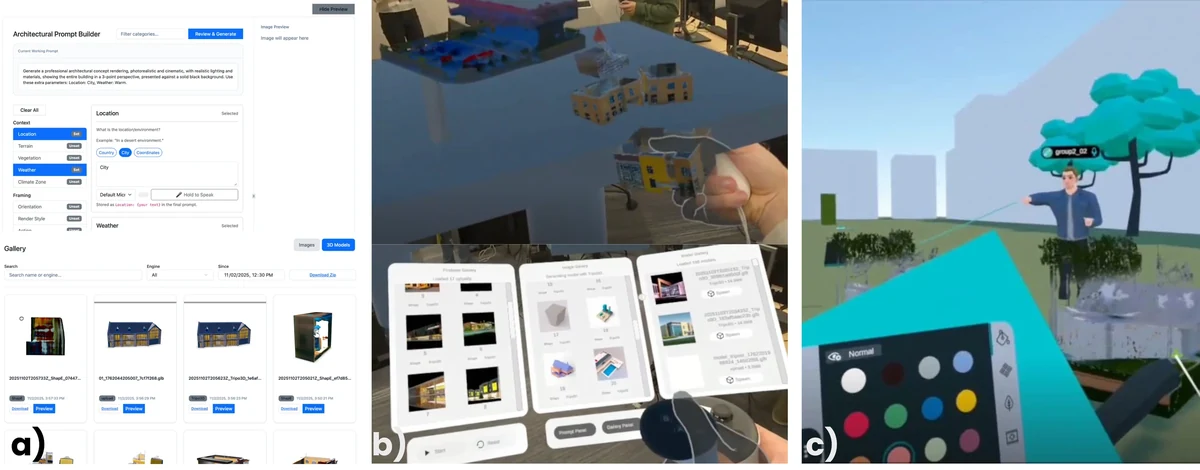
GenARch is a National Science Foundation-funded project exploring how generative AI and a shared immersive environment can support architectural concept development. The project connects prompts, generated imagery, three-dimensional models, and collaborative review in extended reality (XR).
An architectural perspective
Developed as my interdisciplinary senior capstone project, GenARch brought an architectural-engineering perspective into a broader research collaboration. My contributions included conceptualization, software development, investigation, and manuscript writing.
The workflow moves from a written or spoken concept to generated imagery and a three-dimensional model. Shared spatial review included tabletop and full-scale visualization in XR, with Arkio used to examine models, site context, and lighting.
Connecting the workflow to a building
The capstone research revisited Spruce Peak Overlook as an architectural case study, applying GenARch retrospectively to explore the workflow in relation to an existing design. This study connected the technology to questions of architectural concept development and spatial communication.

Learning through evaluation
The current research manuscript examines an architectural studio study involving 27 students across seven teams. Four teams incorporated GenARch into their normal workflow, while three continued without it. Surveys, presentation reviews, and group interviews examined both the design process and the experience of collaboration.
Students used generated images as shared references for discussing ideas, while XR helped them evaluate scale and context. The survey results were mixed: perceived conflict management improved relative to the comparison group, while design confidence and outcome expectancy declined. Presentation scores showed no statistically significant difference between groups.
The findings point to a practical design question: when does each tool help? Generative imagery supported early exploration, immersive views supported spatial review, and precise development still required familiar modeling tools and designer control.
Authored by Maxwell J. Wiesenfeld, Gillian Smith, Max Chen, Nathaniel Powers, Shichao Liu, Soroush Farzin, Yao Xiao.